Part of: Products › Whey protein
Whey protein is the watery part of milk that’s left behind when paneer or cheese is made. It gets filtered and dried into a powder, and one scoop gives you roughly 20 to 25 g of protein that your body digests quickly. That’s really all it is. The rest of this guide covers the types, what a scoop actually contains, how much protein you need, and how to avoid getting cheated on a tub.
Quick answer: what is whey protein
Whey protein is milk protein: the liquid left over when paneer or cheese is made, filtered and dried into a powder. One scoop gives about 20–25 g of fast-digesting protein. It helps you reach your daily protein target, but it builds muscle only if you also do strength training.
- Three types: concentrate, isolate and hydrolysed.
- Most people need just 1 scoop a day. See how to take whey protein.
- Safe for most healthy adults. Check the FSSAI number before you buy.
What is whey protein?
Milk has two main proteins. About 80% is casein and 20% is whey.
If you’ve ever made paneer at home, you’ve already met both. The soft block you keep is mostly casein. The pale yellow water you pour down the sink is whey. Dairies collect that water, filter out most of the fat and milk sugar (lactose), and spray-dry what’s left into a powder. Flavour and sweetener go in at the end.
So whey isn’t a lab chemical. It’s milk, taken apart and dried.
The three types of whey
How long the whey is filtered decides which type you get.
Concentrate (WPC) is the least processed. It’s 70 to 80% protein and keeps a little lactose and fat, which is why it tastes creamier. It’s also the cheapest per gram of protein, so it’s what most people should start with.
Isolate (WPI) is filtered further, to 90% protein or more, with almost no lactose left. If a glass of milk gives you gas, isolate is usually the fix.
Hydrolysate (WPH) is whey that has been partly broken down so it absorbs faster. It costs the most and tastes slightly bitter, and honestly, most people won’t notice any benefit from it.

Still torn between the first two? Our whey concentrate vs isolate guide goes deeper.
What’s in one scoop?
A typical 30 g scoop has 20 to 25 g of protein, 110 to 130 calories, 1 to 5 g of carbs and 1 to 2 g of fat. It also carries about 2.5 g of leucine, the amino acid that acts as the “start repairing” signal for your muscles. You can read more in our leucine guide and the amino acids directory.
These numbers shift from brand to brand, so always check the back of the tub. As a real example, ON Gold Standard 100% Whey lists 24 g protein and 117 kcal in a 30.4 g scoop on its India pack.

What does whey actually do for you?
It makes hitting your protein number easier. That’s the main job. Protein helps muscles recover and grow, but only if you’re also doing some kind of strength training. A shake on its own won’t build muscle.
It also keeps you full for a while, which helps when you’re eating less to lose fat. And for vegetarians, who often struggle to get enough protein from dal and roti alone, it closes the gap without adding much fat or many calories.
Think of it like a mobile recharge. Your meals are the main plan. Whey is the top-up for the days you run short.
How much protein do you need in a day?
The ICMR-NIN recommends 0.83 g of protein per kg of body weight for healthy adults. People who train regularly need more. The International Society of Sports Nutrition suggests 1.4 to 2.0 g per kg.
For a 70 kg person, that’s around 58 g a day if they aren’t active, and somewhere between 98 and 140 g if they’re in the gym three to five days a week. That second number is where most people fall short. Our protein calculator works out your own target in a few seconds.

Whey vs everyday Indian foods
| One serving | Protein |
|---|---|
| 1 scoop whey (30 g) | 20 to 25 g |
| Paneer (100 g) | about 18 g |
| 2 boiled eggs | about 12 g |
| 1 glass milk (250 ml) | about 8 g |
| 1 katori cooked dal | 7 to 9 g |
| Curd (200 g) | about 7 g |
Look at a normal thali and you’ll see the problem. It’s mostly roti and rice, with a katori of dal that gives maybe 8 g of protein. You’d need a lot of katoris to reach 100 g. That gap is exactly where a scoop of whey earns its place.

How and when to take it
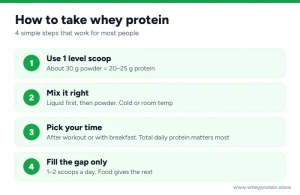
Mix one scoop into 200 to 250 ml of water or milk. Water keeps calories low; milk makes it creamier and adds about 8 g of extra protein. After a workout is the most common time, but having it with breakfast works just as well. What matters is your total for the day, not the exact minute you drink it. Most people only need one, sometimes two, scoops a day.
Is whey safe?
For most healthy adults, yes. It’s a dairy food. The most common complaint is gas or bloating, usually from the lactose in concentrate, and switching to an isolate tends to sort it out. A few people also say it gives them breakouts. The research on this is small, but if you notice it, try an isolate or cut back.
Check with a doctor first if you have kidney disease or a milk allergy, if you’re pregnant, or if the person taking it is under 18.
How to pick a genuine whey in India
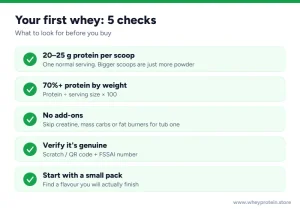
Fake and under-dosed tubs are a real problem here, so a little care before you pay goes a long way. Start with the FSSAI licence number on the label and look it up. Compare protein per scoop, not per 100 g, because brands quietly change scoop sizes. Then read the amino profile. Some makers add cheap amino acids like glycine so the protein number looks bigger, a trick called protein spiking.
After that, look for a lab report from an outside lab, scan the authenticity code on the tub, and buy from the brand’s own store or an authorised seller. Our 7 checks to spot fake whey covers each step.

From the editor: buy what you can keep buying
When I started training, I had to save for three months to afford one tub of protein. Most gym-goers in India are students, and I still meet plenty in that same spot.
So here’s my honest advice. Buy the whey you can afford every single month, not the famous tub once. One tub won’t change your body. Results are slow, and they come from months of steady protein, training and sleep. Whether it says Optimum Nutrition or a cheaper Indian brand matters far less than not stopping.
And remember why you’re doing it. Supplements are there to help you stay fit and healthy first. The six-pack can come later.
— Lovely, editor at wheyprotein.store.
Where to start
Work out your daily protein target, then add up roughly what you already eat. If you’re short by 20 g or more, one scoop a day covers it. Pick a concentrate to save money, or an isolate if milk upsets your stomach. And if your real problem is that you can’t gain weight at all, read whey protein vs mass gainer before you buy anything.
When you’re ready, browse all whey proteins with label facts and protein per scoop side by side.
Key takeaways
- Whey is about 20% of milk protein. Casein is the other 80%.
- One 30 g scoop: 20–25 g protein, 110–130 calories.
- ICMR-NIN suggests 0.83 g protein per kg for adults. Active people need more.
- Whey fills the gap your food leaves. It doesn’t replace meals.
- Gas or bloating? Try an isolate.
- Fake tubs are common in India, so buy from official sellers.
FAQs
Is whey protein vegetarian?
Yes. It is made from milk, so it is vegetarian. It is not vegan.
Can beginners take whey protein?
Yes. You don’t need to be a bodybuilder. If your meals are low on protein, whey is a simple way to fill the gap.
Can I take whey protein without going to the gym?
You can, if your diet is short on protein. Count it as part of your daily food so you don’t overshoot your calories.
Which is better, whey concentrate or isolate?
Concentrate is cheaper and fine for most people. Isolate suits you better if milk upsets your stomach or you want fewer carbs.
Does whey protein make you fat?
Not by itself. One scoop has about as many calories as a glass of milk. Weight gain comes from eating more than you burn over weeks.
How long does 1 kg of whey last?
About 33 scoops of 30 g, so roughly a month at one scoop a day.
This guide is for general education. Speak to a doctor or dietitian about your own health goals.
Whey protein ka matlab kya hota hai?
Whey ka matlab hai doodh ka woh paani jo paneer ya cheese banate waqt bachta hai. Isi ko filter karke aur sukha kar powder banaya jata hai, jisme zyada tar protein hota hai.
What is the nutritional value of whey protein per 100 g?
It depends on the type. Per 100 g, a typical concentrate has about 70–80 g protein and 380–400 calories, while an isolate has about 90 g protein. Carbs and fat are low in both. Always check your tub’s label for exact numbers.
Whey protein or plant protein: which is better?
Whey digests fast and has more leucine per scoop, so it’s slightly better for muscle gram for gram. Plant protein (pea, soy or blends) suits vegans and people with a milk allergy. Both work if you hit your daily protein target.