Part of: Products › Whey protein
Whey concentrate and whey isolate both come from milk and both build muscle. The difference is how much gets filtered out. Isolate goes through extra filtering, so it has more protein and less lactose, fat and carbs, and it usually costs more. Whether that’s worth paying for depends mostly on your stomach.
Quick answer: whey concentrate vs isolate
Pick whey concentrate if milk and curd suit you and you want more protein per rupee. Pick isolate if dairy gives you gas or you’re cutting calories hard. Both build the same muscle. Isolate is just filtered more, so it’s about 90% protein against 70–80% for concentrate.
- Isolate has very little lactose. Concentrate has a few grams per 100 g.
- Blends sit in between. The first ingredient on the label is the main one.
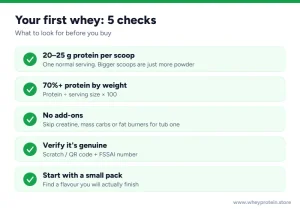
- Check protein %: 70%+ is fair for concentrate, 80%+ for isolate.
The difference in one table
| Whey concentrate (WPC) | Whey isolate (WPI) | |
|---|---|---|
| Protein by weight | About 70–80% | About 90% or more |
| Protein per scoop | Usually 22–25 g | Usually 25–27 g |
| Lactose | Some, a few grams per 100 g | Very little, under 1 g per scoop |
| Carbs and fat | A little more | Very low |
| Taste | Creamier | Lighter, thinner |
| Price per gram of protein | Lower | Higher |
Which one should you choose?
If milk, curd and chai never bother you, concentrate is the sensible pick. You get more protein per rupee and a creamier shake.
Isolate earns its price in two cases. The first is when regular milk gives you gas or bloating, because isolate has almost no lactose. The second is when you’re cutting and counting every gram of carb and fat. If you just want the most protein per scoop, isolate wins there too, by 2 or 3 g.
Does isolate build more muscle?
Not in any way you’d notice in the mirror. Muscle comes from your total protein across the day and your training. Find your target with our protein intake calculator, then pick the type your stomach and budget like.
Blends and hydrolysed whey
Many popular tubs are blends. ON Gold Standard 100% Whey, for example, lists isolate first, then concentrate, then hydrolysed whey. The first ingredient on the list is always the biggest, so that one line tells you what you’re mostly paying for.
Hydrolysed whey is whey that has been partly broken down so it digests a little faster. It costs more and tastes slightly bitter, and most people won’t feel any difference.
From the editor: what “blend” really tells you
Indian labels must list ingredients from largest to smallest by weight, but they don’t have to say how much of each. So a “whey blend” with isolate listed first could be mostly isolate, or only a little more isolate than concentrate. The second ingredient can be a tiny amount. If the label doesn’t print percentages, judge it by protein per scoop, or ask the brand directly.
— Lovely, editor at wheyprotein.store.
Two MuscleBlaze tubs side by side
Biozyme Performance Whey is a concentrate with 25 g protein in a 36 g scoop, which works out to about 69% protein. Biozyme Iso-Zero is an isolate with 27 g protein in a 34 g scoop, about 79% protein and 1.7 g carbs. Put them next to each other on the compare page.
How to read the label
Divide protein per serving by the serving size to get protein %. For flavoured products, 70% or more is fair for a concentrate and 80% or more for an isolate. Then check the first ingredient to see which type dominates. Last, scan for added amino acids like glycine or taurine, which can push up the protein number without adding real whey.
Still deciding whether you even need whey, or something with more calories? Read whey protein vs mass gainer, or browse all whey proteins.
Key takeaways
- Both come from milk and both build muscle.
- Isolate: about 90% protein, very little lactose, costs more.
- Concentrate: 70–80% protein, creamier, better value.
- Your total daily protein matters far more than the type.
- Lactose trouble? Go isolate, mixed with water.
- Do the label maths: protein ÷ serving size × 100.
FAQs
Is whey isolate better than concentrate?
Not for everyone. Isolate is purer and easier on a lactose-sensitive stomach. Concentrate gives the same muscle benefit for less money.
Can lactose-intolerant people take whey?
Many people with mild lactose intolerance do fine on isolate. If yours is strong, start with half a scoop or try a plant protein.
Is whey concentrate bad for weight loss?
No. It has only a few more grams of carbs and fat per scoop. Your total calories over the day matter far more.
Which is better for beginners?
Most beginners do well on a concentrate, unless milk upsets their stomach.
Whey isolate aur concentrate mein kya fark hai?
Isolate zyada filter hota hai, isliye usme protein lagbhag 90% aur lactose bahut kam hota hai. Concentrate sasta hota hai aur 70–80% protein deta hai. Agar doodh aapko suit karta hai, to concentrate theek hai.
Can I mix whey isolate with milk?
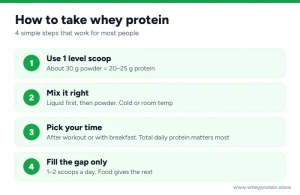
Yes. But milk brings its own lactose, so if you chose isolate to avoid lactose, mix it with water instead.