Part of: Products › Whey protein
How to take whey protein is simple once you know four things: how much to use, what to mix it with, when to drink it, and how much protein you need in a day. Most people get one of these wrong and then think the powder “isn’t working.”
Below you’ll find the dose, the mix, the timing, and two full Indian days of eating that show how one scoop fits in.
New to whey? Start with our whey protein guide first, then come back here.
Quick answer: how to take whey protein
Take 1 level scoop (about 20–25 g protein) mixed in 200–300 ml of cold water or milk, once or twice a day. Use water for fat loss and milk for weight gain. Drink it after your workout or with breakfast. What matters most is hitting your total protein for the day, not the exact time.
- 1–2 scoops a day is enough for most people. Food covers the rest.
- Liquid first, then powder. Never hot liquid.
- New to whey? Start with half a scoop for 3–4 days.
Step 1: Use the right amount (one scoop is one serving)
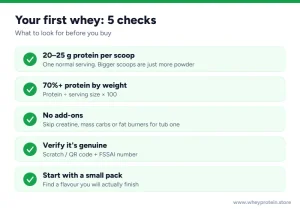
Every tub comes with a scoop. Use it, and read the label to see what one scoop gives you. Most whey tubs in India give about 20–25 g of protein per scoop.
- Use a level scoop, not a heaped one. A heaped scoop can be 20–30% extra powder, and your tub runs out faster.
- Lost the scoop? A kitchen scale works. Weigh the serving size printed on the label (often 30–33 g).
- Per meal, 20–40 g of protein is the range the International Society of Sports Nutrition (ISSN) suggests for building muscle. One scoop sits right in that range.
Three scoops in one go won’t build three times the muscle. Your body uses what it needs, and the rest ends up as extra calories.
How many scoops of whey protein per day?
For most people, 1–2 scoops a day is enough.
Your daily protein need depends on your body weight and how active you are:
| Who you are | Protein per kg body weight per day | For a 70 kg person |
|---|---|---|
| Not very active adult | about 0.8–1.0 g | 56–70 g |
| Working out 3–5 days a week | 1.4–2.0 g | 98–140 g |
The first row is close to what India’s ICMR-NIN recommends for adults. The second row is the ISSN range for people who train.
Now do the simple maths:
- Work out your daily target (use our protein calculator).
- Count what your food already gives you: dal, paneer, curd, eggs, chicken, soya, milk.
- Fill the gap with whey. If the gap is 25 g, that’s 1 scoop. If it’s 50 g, that’s 2.
If your food already covers your target, you don’t need whey at all. Think of it as a shortcut. Plenty of fit people never touch it.
Is 3 scoops a day too much?
- For a big, very active person with a high target, it can fit. For most people, it’s more than they need.
- Too much powder often means bloating, gas and fewer real meals.
- Have a health condition? Read who should ask a doctor first.
Whey protein with milk or water?
Both work. Pick based on your goal, because most gym advice on this is just habit.

| With water (250 ml) | With toned milk (250 ml) | |
|---|---|---|
| Extra calories | 0 | about 145 |
| Extra protein | 0 | about 8 g |
| Taste | Lighter, thinner | Creamier, more like a milkshake |
| Digestion | Faster, lighter on the stomach | Slower, keeps you full longer |
| Best for | Fat loss, after workout, lactose-sensitive people | Weight gain, skinny people, a meal replacement snack |
Numbers are approximate. Check your milk packet, because toned, double-toned and full-cream milk differ.
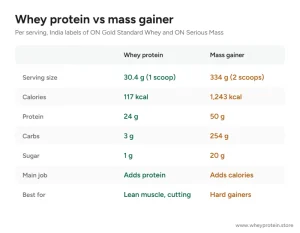
Trying to bulk up? Read whey protein vs mass gainer before you buy a gainer. Whey plus milk often does the same job for less money.
Whey protein ko milk ke sath le sakte hain?
Haan, bilkul le sakte hain. Milk ke sath whey lene se calories aur protein dono badh jaate hain, isliye weight gain ke liye yeh achha hai. Weight loss kar rahe hain to paani ke sath lena behtar hai. Agar doodh se gas ya pet bhaari lagta hai, to paani chuniye ya whey isolate try kariye.
What about lactose?
- Whey comes from milk, so it has some lactose.
- Whey concentrate has more lactose. Whey isolate has very little.
- If normal milk upsets your stomach, mix isolate with water. It’s the easiest combo on the stomach.
Step 2: Mix it properly (no lumps)
Lumps put a lot of people off whey. They’re easy to avoid:
- Liquid first, powder second. Pour 200–300 ml water or milk into the shaker, then add the scoop. Powder at the bottom sticks.
- Use cold or room-temperature liquid. Hot liquid makes whey clump.
- Shake for 15–20 seconds with the lid tight. A shaker with a mesh ball or spring works best.
- Drink it within 30 minutes of mixing, especially with milk. Milk shakes left out in Indian heat go bad fast.
No shaker? A mixie jar works well and gives you a smoother shake. A spoon and glass works too, but stir it slowly into a paste with a little liquid first.
Can you mix whey in hot milk, chai or coffee?
- Heat changes the shape of whey (it “denatures”), and that causes clumps.
- It does not destroy the protein. Cooked eggs and paneer are denatured too, and your body still uses that protein fine.
- So the only real issue is texture. Want it warm? Let the milk cool a little, then stir the powder in slowly.
Step 3: Pick a time that fits your day
Gym talk makes timing sound like a big deal. The research doesn’t. A 2013 review of protein timing studies found that total daily protein mattered much more than taking it at an exact time around the workout.
In practice, the best time is whichever one you’ll actually remember every day.

Whey protein before or after workout?
| Timing | Good for | Keep in mind |
|---|---|---|
| After workout (within 1–2 hours) | The most common habit. Easy to remember. | You don’t need to rush. There’s no 30-minute “window” panic. |
| Before workout (30–60 min) | If you train in the morning on an empty stomach. | Some people feel heavy. Try it with water and a smaller amount. |
| With breakfast | Indian breakfasts (poha, paratha, upma) are often low in protein. | Easy way to balance a carb-heavy plate. |
| As an evening snack | Replaces biscuits, namkeen or samosa. | Keeps you full till dinner. |
What about rest days?
Yes, take it on rest days too, if your food doesn’t cover your protein. Muscles repair and grow on rest days. Just keep the same daily target.
Empty stomach or after food?
- Both are okay for most people.
- On an empty stomach it digests faster.
- If it causes acidity or gas, take it after a light meal instead.
Before bed?
Whey digests fast, so it’s not the classic bedtime protein. If dinner was light and you’re short on protein for the day, a scoop before bed is still fine. Many people prefer a bowl of curd or a glass of milk at night instead.
Step 4: Use whey in food, not just shakes
Bored of shakes? Whey also goes into a lot of everyday Indian food. Add it after cooking or to cold dishes so it doesn’t clump.
- Overnight oats: oats + milk + 1 scoop + banana, into the fridge.
- Curd bowl: stir half a scoop into a bowl of dahi with fruit.
- Lassi or smoothie: blend with curd, banana and a few dates.
- Besan or atta pancakes: replace a little flour with whey (cook on low flame).
- Cold coffee: chocolate or coffee whey + cold milk + ice in the mixie.
Find more ideas in our protein recipes.
Sample day: how to take whey protein (70 kg person, gym 4 days a week)
Target: about 110 g protein a day. Here’s one simple way to reach it:
| Meal | Food | Protein (approx.) |
|---|---|---|
| Breakfast | 2 boiled eggs + 1 roti | 15 g |
| Post-workout | 1 scoop whey with water | 24 g |
| Lunch | Dal, rice, sabzi, a bowl of curd | 20 g |
| Evening | Roasted chana (40 g) + a glass of milk | 15 g |
| Dinner | Chicken curry (150 g chicken) + 2 rotis | 36 g |
| Total | about 110 g |
Vegetarian version (same person)
| Meal | Food | Protein (approx.) |
|---|---|---|
| Breakfast | 100 g paneer bhurji + 1 roti | 21 g |
| Post-workout | 1 scoop whey with water | 24 g |
| Lunch | Rajma or dal, rice, a bowl of curd | 22 g |
| Evening | Roasted chana (40 g) + a glass of milk | 15 g |
| Dinner | Soya chunks curry (30 g dry) + 2 rotis | 22 g |
| Total | about 104 g |
Both days use just one scoop. Food does the heavy lifting. Short by a few grams? Add a second half-scoop with breakfast.
Change how you take it based on your goal
| Goal | Mix with | Scoops a day | Best time |
|---|---|---|---|
| Fat loss | Water | 1 | As a snack, to replace biscuits or namkeen |
| Muscle gain | Water or milk | 1–2 | After workout + with breakfast |
| Weight gain (skinny) | Full-cream milk + banana | 1–2 | Between meals |
| Busy, just want more protein | Whatever you like | 1 | With breakfast |
For fat loss, the shake works best when it replaces a junk snack, not when it’s added on top of everything you already eat. For weight gain, the milk and banana do as much work as the whey.
4 common mistakes
- Skipping meals and drinking shakes instead. Whey is a supplement. Food gives you fibre, vitamins and minerals that powder doesn’t.
- Thinking more is better. 4–5 scoops a day rarely helps and often bloats.
- Not drinking enough water. More protein means your body needs more water. Aim to drink regularly through the day.
- Buying a fake tub. In India, this is a real risk. Learn how to spot fake whey protein before you buy.
Who should ask a doctor first
- People with kidney or liver disease.
- Pregnant or breastfeeding women.
- Teenagers under 18 (food first is the better route).
- Anyone on regular medicines or with a milk allergy (not the same as lactose intolerance).
India’s ICMR-NIN guidelines prefer protein from food and are cautious about protein powders. So use whey to fill a gap, not to replace meals. Our whey protein side effects guide covers kidney, liver and gut questions in detail.
Scoop sizes differ by brand: check the label, not the scoop
“1 scoop” is not a fixed amount. One brand’s scoop can hold around 30 g of powder, another’s 35–40 g or more. Flavour changes it too.
- Look for “serving size” and “protein per serving” on the nutrition table.
- Quick check: protein ÷ serving size × 100. Under 70% means you’re paying for a lot of filler, carbs or sugar.
- Example: 24 g protein in a 30 g serving = 80%. Good. 24 g in a 40 g serving = 60%. Not great.
- Lactose-sensitive? An isolate usually scores 85–90%. See whey concentrate vs isolate.
We list the label numbers for every product in our product directory, so you can compare quickly.
Key takeaways
- Work out your daily protein target first. Whey only fills the gap your food leaves.
- One level scoop per serving. Two scoops a day is the usual upper limit for most people.
- Water keeps calories low. Milk adds about 145 calories and 8 g protein per glass.
- Any time of day works. Pick the time you’ll remember daily.
- Scoop sizes differ by brand, so read the label. Aim for 70%+ protein per serving.
- Kidney or liver issues, pregnancy, or under 18? Ask a doctor first.
FAQs
How to take whey protein for the first time?
Start with half a scoop in 200 ml water for 3–4 days. If your stomach is fine, move to a full scoop. This helps you spot any gas or bloating early.
Can I take whey protein without working out?
Yes, if your diet is low in protein. But without exercise it won’t build muscle by itself. It just adds protein and calories. For most non-active people, better food choices are enough.
Can I take whey protein twice a day?
Yes. Two scoops a day is common for active people with higher protein needs. Spread them out, for example one after the workout and one with breakfast.
Can women take whey protein?
Yes. Whey is just milk protein, and it won’t make women bulky. The same dose rules apply. See the doctor list above if you’re pregnant or breastfeeding.
How long does a 1 kg tub last?
A 1 kg tub has about 30 scoops. At 1 scoop a day, that’s about a month. At 2 scoops a day, about 2 weeks.